
What is a Bonding?
Bonding is the electrical connection of conductive metal parts so they remain at nearly the same voltage. Bonding joins equipment enclosures, metal raceways, piping, and other conductive paths to create a low-impedance route for fault current. That route helps protective devices, such as circuit breakers, open the circuit during a fault.
Quick Facts About Bonding
Category
Electrical safety method
Used for
Connecting conductive parts for fault-current return
Common confusion
Bonding is not the same as grounding
Also called
Equipotential bonding, Electrical bonding
Often discussed with
Electrical Code Corrections, Electrical Panel Upgrades
Key Takeaways About Bonding
- Bonding keeps metal parts that people can touch at nearly the same electrical potential.
- A low-impedance bonding path helps a circuit breaker clear faults fast.
- Bonding differs from grounding. But both support electrical safety.
- Loose, corroded, painted, or missing connections can weaken a bonding path.
Understanding Bonding
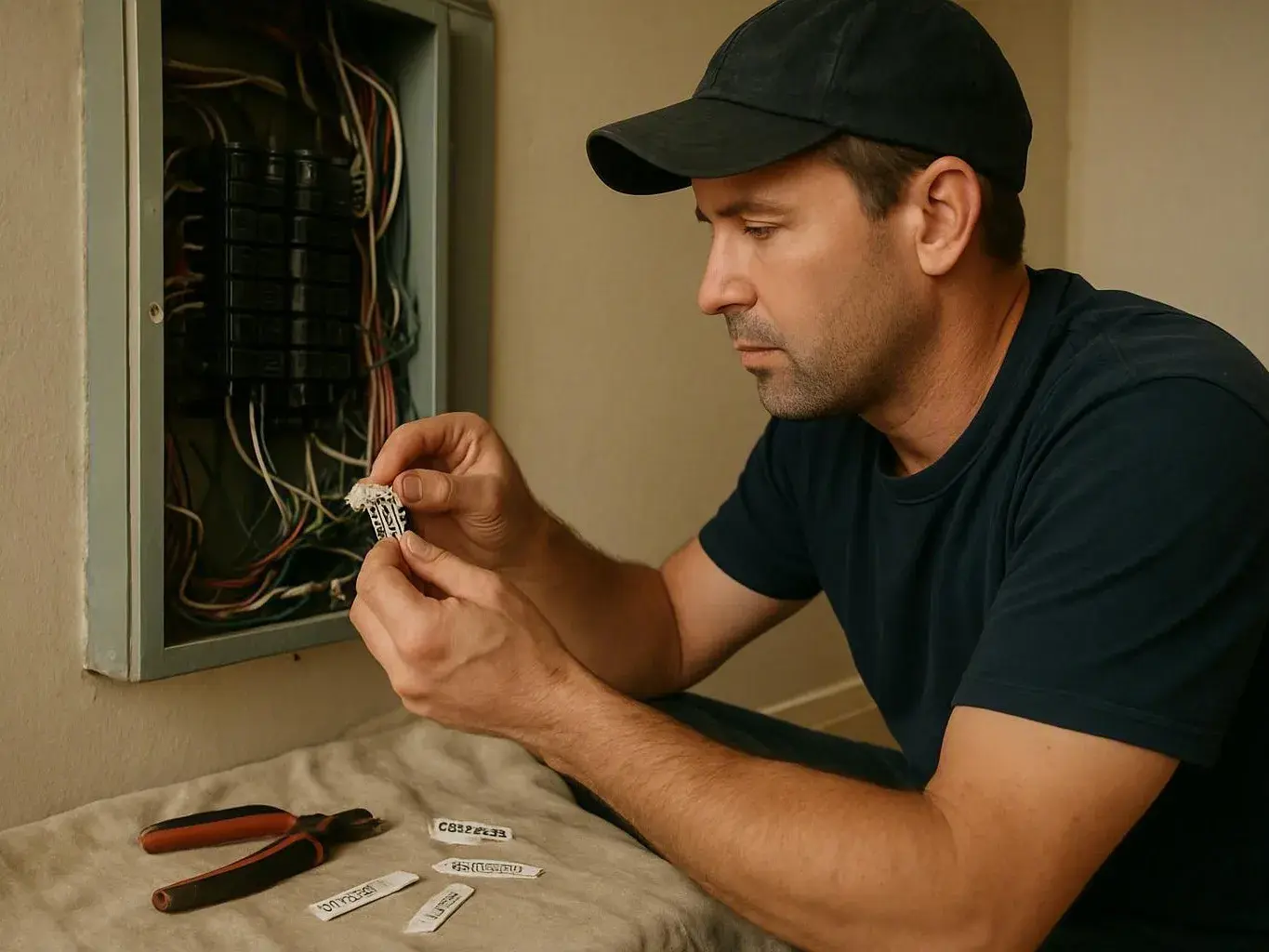
Bonding connects conductive metal parts in an electrical system. These parts can include equipment enclosures, metal raceways, cable armor, water piping, and service equipment. The goal is to keep connected metal parts at nearly the same electrical potential. This reduces dangerous voltage differences between surfaces a person might touch.
Related glossary terms: Electrical Ground, Grounding Electrode, National Electrical Code.
A bonding path normally carries no current during regular operation. It becomes active when a faultplaces energized voltage on metal that should remain safe to touch. The path then gives fault current a low-resistance route back to the source. That current helps.circuit breaker or fuse open the circuit.
How Bonding Works, Is Measured, or Is Used?
Electricians create bonding with approved conductors, bonding jumpers, listed fittings, grounding terminals, and other equipment designed for the application. At service equipment, the grounded conductor and equipment grounding system connect at a defined point. Downstream panels normally keep neutral conductors isolated from equipment grounding conductors. This prevents normal neutral current from flowing on metal parts.
The effectiveness of a bonding path depends on a continuous metal connection and low impedance. An electrician may inspect conductor size, terminal tightness, fitting type, corrosion, paint, and mechanical damage. Tests can include continuity checks and measurements of resistance or fault-loop impedance. The acceptable result depends on the system design and applicable electrical code. A visual reading alone can't prove that every connection will carry fault current safely.
Why Bonding Matters?

Without effective bonding, a damaged wire can energize a metal enclosure while the protective device remains closed. A person touching that enclosure and another grounded surface could become part of the fault path. Proper bonding lowers this risk by supporting fast operation of the overcurrent protection.
Bonding also supports reliable operation of ground-fault circuit interrupters and other protective equipment. It helps limit stray voltage on metal piping and equipment. It reduces unwanted current on building parts. It supports the safety design of the electrical system. The connection must remain intact after repairs, equipment changes, and panel work.
When Bonding Matters Most?
Bonding deserves close attention during a panelboard replacement, service upgrade, generator installation, or renovation. This includes work that adds metal raceways and equipment. It also matters where metal water piping, gas piping, structural steel, or separately derived systems are present. Different systems require different connection points and conductor rules.
Warning signs include a loose grounding screw, a missing bonding jumper, painted contact surfaces, corrosion, damaged raceway fittings, or a neutral wire connected incorrectly in a downstream panel. Don't remove a bonding connection because an enclosure appears quiet during normal use. A qualified electrician should identify the system arrangement, test the path, and correct defects under the applicable code requirements.
How to Evaluate Bonding?
- Check whether every required metal enclosure, raceway, and equipment grounding conductor has a continuous connection.
- Inspect bonding screws, jumpers, terminals, and fittings for looseness, corrosion, paint, or mechanical damage.
- Confirm that neutral-to-ground connections occur only at permitted locations for the system.
- Ask whether continuity or fault-loop testing supports the visual inspection.
- Compare conductor sizes and connection methods with the applicable National Electrical Code requirements.
Related Concepts Compared
Bonding vs. Electrical Ground
Grounding connects an electrical system or equipment to earth or to a grounding reference. Bonding connects conductive parts together so fault current has a reliable return path.
Bonding vs. Grounding Electrode
A grounding electrode is a conductive object, such as a ground rod or concrete-encased electrode, that connects a system to earth. An electrode does not replace required bonding between metal equipment parts.
Bonding vs. Grounding Jumper
A grounding jumper is a conductor used to connect grounding points. It can perform a bonding function when it joins metal parts or connects grounded and grounding conductors at an approved location.
Expert Note
A bonding connection can look intact while failing under fault current. Paint, thread sealant, corrosion, loose hardware, and incorrect panel connections can add impedance. Inspection should cover the full path from the metal part back to the source, not just the nearest screw or terminal.
Common Mistakes or Myths About Bonding
- Treating a ground rod as a substitute for bonding metal enclosures.
- Leaving a neutral-to-ground bond in a downstream panel.
- Installing a bonding jumper across paint, rust, or another poor contact surface.
- Assuming a continuity beep proves that the path can carry fault current safely.
Bonding in Practice: A Real-World Example
A metal junction box gets a fault after damaged insulation. A proper bonding wire carries fault current back to the panel, so the circuit breaker trips. A loose or missing path may leave the box live until someone finds the fault.
Sources & Further Reading on Bonding
Related Terms
Electrical Ground
Electrical Ground is a conductive connection that provides a safe path for unwanted electrical current to…
Grounding Electrode
Grounding Electrode is a conductive object that connects an electrical system to the earth. Common examples…
National Electrical Code
National Electrical Code is a widely adopted safety standard for designing, installing, and inspecting electrical systems…
Panelboard
Panelboard is an enclosed electrical distribution assembly that receives power and sends it through branch circuits…
Chris Miller Electric
Have Questions About Bonding?
Contact Chris Miller Electric for practical guidance on Bonding and related 24 hour electrician work in Fort Wayne.