
What is an Ampacity?
Ampacity is the maximum current, measured in amperes, that a conductor can carry continuously under specified conditions without exceeding its allowed temperature. The value depends on wire material, size, insulation rating, ambient temperature, installation method, and nearby conductors. Electricians use ampacity to select safe conductors, overcurrent protection, and equipment connections.
Quick Facts About Ampacity
Category
Electrical safety metric
Measured by
Amperes, or amps
Used for
Conductor and overcurrent protection sizing
Common confusion
Ampacity is not the same as amperage
Also called
Current-carrying capacity, Conductor ampacity
Often discussed with
Electrical Panel Upgrades, Electrical Code Corrections
Key Takeaways About Ampacity
- Ampacity describes a conductor’s safe current capacity under stated installation conditions.
- Wire size alone does not set ampacity because heat and setup conditions also affect safe current capacity.
- A circuit breaker protects conductors by stopping current before dangerous overheating occurs.
- Electricians compare conductor ampacity with load demand and electrical code rules.
- Exceeding ampacity can damage insulation, create fire hazards, and shorten equipment life.
Understanding Ampacity
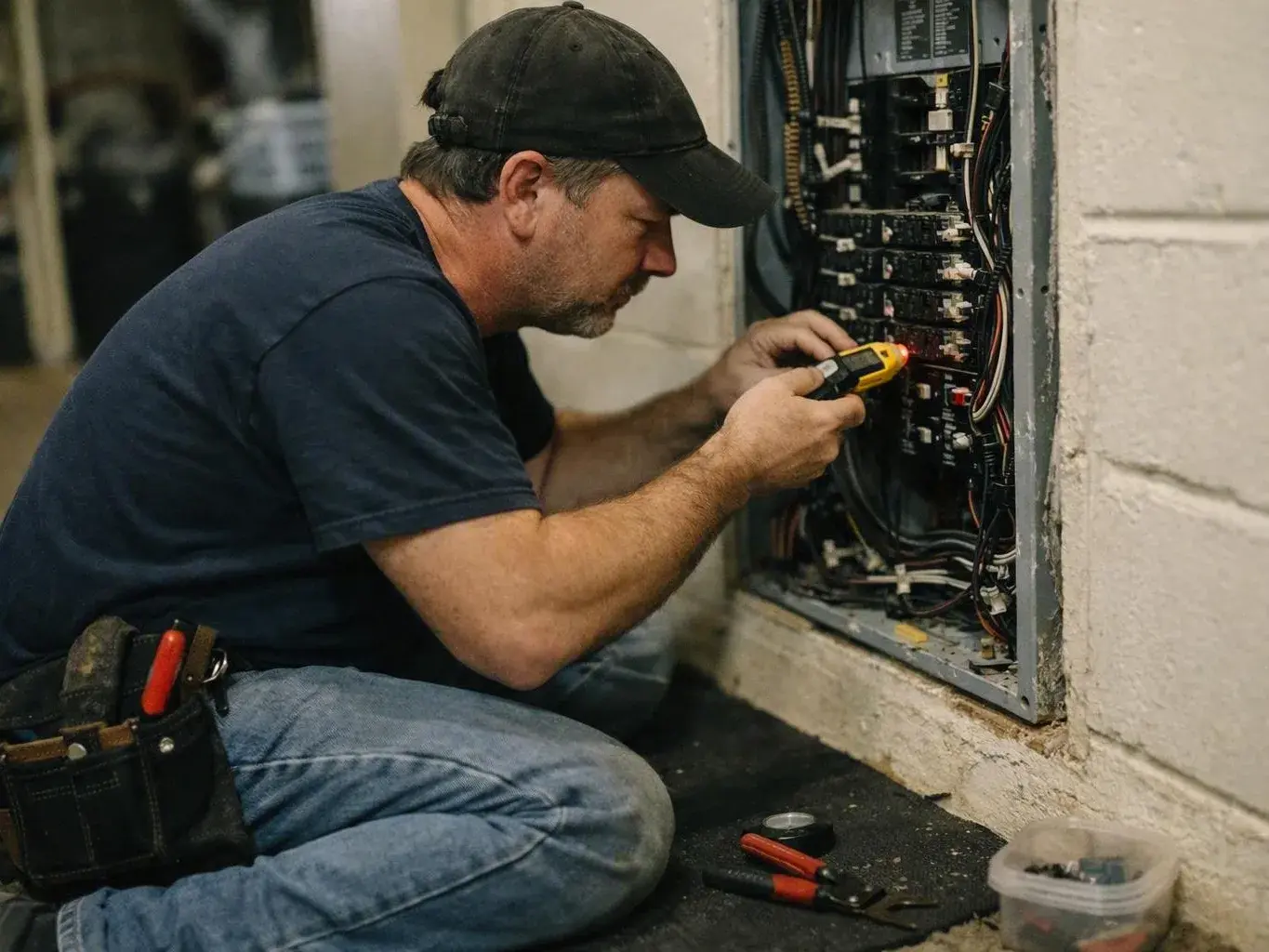
Ampacity is the current-carrying capacity of an electrical conductor. It shows how much current a wire or cable can carry. The temperature must stay below its insulation and construction limits. The rating applies to specific conditions. The same conductor may have different ampacity values in different installations.
Related glossary terms: American Wire Gauge, Amperage, Circuit Breaker.
Heat is the main concern. Current flowing through electrical resistance produces heat inside a conductor. Poor heat release raises the conductor temperature. Wire material, conductor size, insulation temperature rating, and ambient temperature affect the rating. Conduit fill and nearby current-carrying conductors also affect it. Ampacity is more than a wire-size label.
How Ampacity Works, Is Measured, or Is Used?
Electricians determine ampacity by matching conductor traits with the applicable National Electrical Code rules. They also consider the installation conditions. Copper and aluminum conductors have different resistance and heat behavior. Insulation types have different temperature limits. Reference tables provide starting values. Adjustment and correction factors may change the allowable current.
A circuit design compares the expected load current with conductor ampacity. It also compares the rating of the overcurrent protection device. The breaker or fuse must protect the conductor. It must not simply match the connected appliance. An expert may check terminal ratings and motor starting current. They may also check continuous loads and voltage drop. Equipment instructions may guide the final conductor and breaker choice.
- Identify the conductor material, size, insulation rating, and installation method.
- Determine the expected load and whether the load operates continuously.
- Apply temperature, conduit-fill, bundling, and termination limits.
- Choose compatible overcurrent protection and verify the completed circuit.
Why Ampacity Matters?

Correct ampacity keeps a conductor within its safe temperature range. This applies during normal operation. An undersized conductor can overheat. The connected equipment may still appear to work normally. Repeated overheating can damage insulation and loosen connections. It can also increase resistance and create a fire risk.
Ampacity also supports reliable electrical design. A conductor with too little capacity may cause nuisance breaker trips. It may cause dimming, voltage loss, or equipment failure. A larger conductor isn't always a complete solution. The breaker, terminals, raceway, panelboard, and load must remain compatible.
When Ampacity Matters Most?
Ampacity becomes especially important during panelboard upgrades and new circuits. It also matters for electric vehicle charger installations. Heating equipment work and service changes need careful ampacity checks. It matters when someone replaces a fuse or breaker with a higher-rated device. Increasing the protective device can remove wire protection. Always confirm conductor capacity before making this change.
Older wiring may have damaged insulation or altered splices. It may also have crowded enclosures or connections that can't accept modern conductor sizes. A proper evaluation checks the full circuit. It doesn't rely on one cable's printed marking. For code-sensitive work, the applicable edition of the electrical code should guide the design. Local amendments and equipment instructions should guide inspection too.
How to Evaluate Ampacity?
- Check the conductor material, gauge, insulation rating, and listed ampacity.
- Compare expected load current with conductor capacity and overcurrent device rating.
- Look for conduit fill, bundled cables, high ambient temperature, or crowded terminations.
- Confirm that breaker, conductor, terminals, and equipment ratings are compatible.
- Ask whether continuous loads, motor starting current, and voltage drop were evaluated.
Related Concepts Compared
Ampacity vs. Amperage
Amperage is the amount of current flowing through a circuit at a given time. Ampacity is the maximum current a conductor is designed to carry safely under stated conditions.
Ampacity vs. American Wire Gauge
American Wire Gauge, or AWG, identifies conductor size. AWG affects ampacity, but ampacity also depends on insulation, temperature, installation method, and other conditions.
Ampacity vs. Overloaded Circuit
An overloaded circuit carries more current than its circuit or conductors can safely support. Ampacity is the capacity used to judge whether that condition exists.
Ampacity vs. Voltage Drop
Voltage drop is the reduction in voltage along a conductor as current travels through resistance. A circuit can meet ampacity requirements and still need a larger conductor to control voltage drop.
Expert Note
Do not size a circuit from wire gauge alone. Field conditions can reduce allowable ampacity, and the lowest-rated termination or connected component can control the final design.
Common Mistakes or Myths About Ampacity
- Assuming a larger breaker makes an undersized wire safe.
- Treating wire gauge as the only factor that determines ampacity.
- Ignoring heat, conduit fill, bundling, or ambient temperature.
- Confusing the circuit’s actual amperage with the conductor’s ampacity.
- Using a conductor without checking its insulation and terminal temperature ratings.
Ampacity in Practice: A Real-World Example
A new electric range needs a dedicated circuit. The electrician checks load, conductor material, insulation rating, path, terminals, and breaker. A crowded conduit may lower allowed ampacity and require a different conductor size.
Sources & Further Reading on Ampacity
Related Terms
American Wire Gauge
American Wire Gauge is a standardized system that identifies electrical wire diameter with numbered sizes. Smaller…
Amperage
Amperage is the amount of electric current flowing through a circuit, measured in amperes, also called…
Circuit Breaker
Circuit Breaker is an automatic electrical safety device that opens a circuit when current exceeds a…
Load Calculation
Load Calculation is a method for estimating the electrical demand a building or circuIt'll place on…
Chris Miller Electric
Have Questions About Ampacity?
Contact Chris Miller Electric for practical guidance on Ampacity and related 24 hour electrician work in Fort Wayne.