
What is Interrupting Rating?
Interrupting Rating is the highest fault current that a circuit breaker, fuse, or similar protective device can safely stop at a stated voltage. Manufacturers express the rating in amperes, often as kAIC, meaning kiloamperes interrupting capacity. The rating must meet or exceed the available short-circuit current at the device location.
Quick Facts About Interrupting Rating
Category
Electrical safety rating
Measured by
Amperes or kAIC
Used for
Selecting breakers and fuses
Common confusion
Not the same as ampere rating
Also called
Interrupting capacity, Interrupting current rating
Often discussed with
Electrical Panel Upgrades, Electrical Service Upgrades
Key Takeaways About Interrupting Rating
- The rating covers fault current, not the circuit’s normal load.
- A device’s interrupting rating must meet or exceed available fault current.
- Manufacturers often list the value in amperes or kiloamperes interrupting capacity.
- Voltage and the installation site affect if a rating is enough.
- An underrated device can fail with great force during a severe short circuit.
Understanding Interrupting Rating
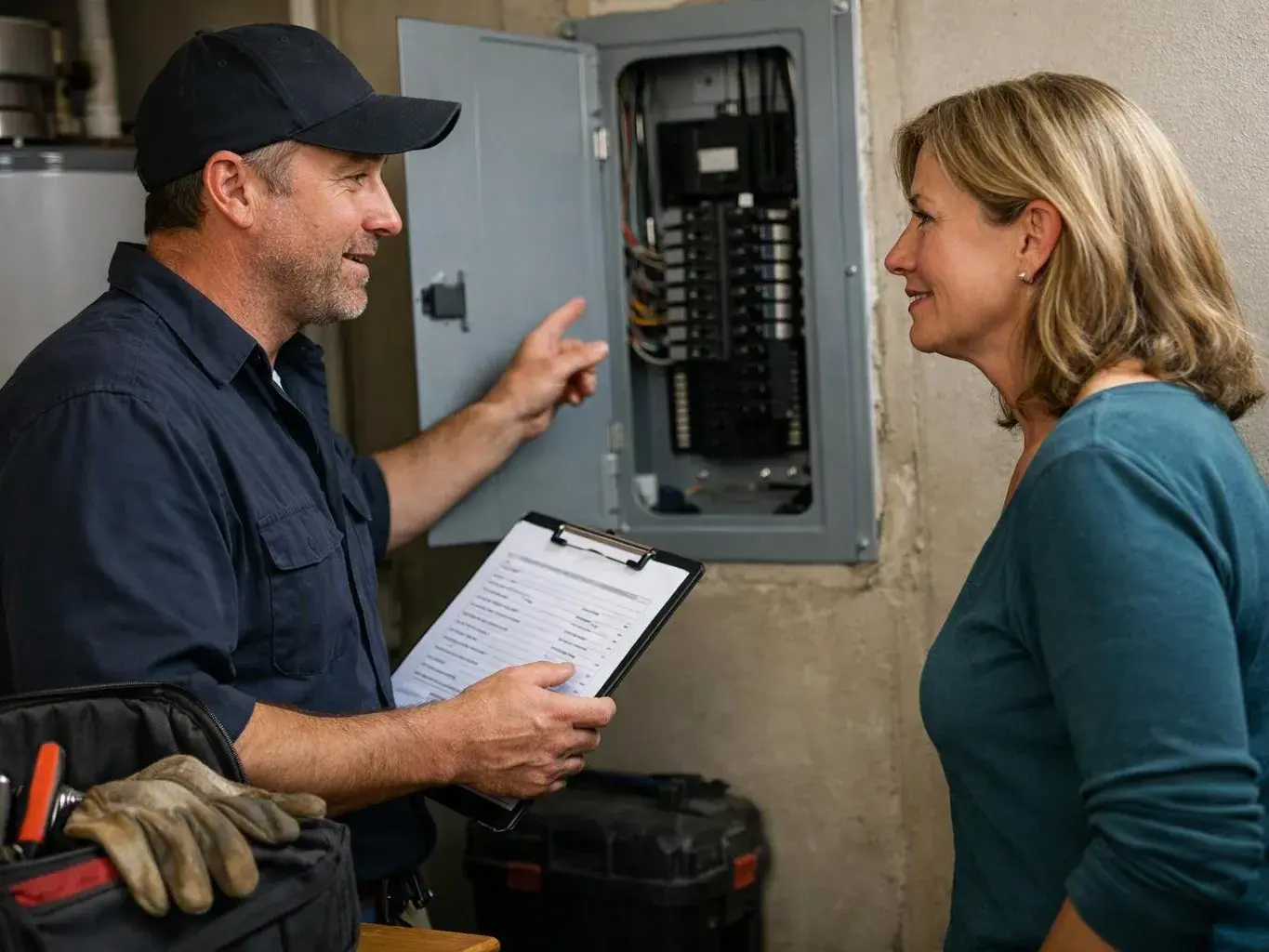
Interrupting Rating identifies the maximum short-circuit current. A protective device can safely interrupt it at a specified voltage. A circuit breaker or fuse may carry normal current for years. Yet it may face thousands of amperes during a fault. The rating addresses that fault event. It doesn't address everyday current flowing through the circuit.
Related glossary terms: Circuit Breaker, Fuse, Short Circuit.
Manufacturers usually mark the value in amperes or kiloamperes. A label such.10 kAIC means the device can interrupt up to 10,000 amperes. This applies under the stated conditions. The rating belongs to the device. You must consider its voltage, phase arrangement, system design, and installation location.
How Interrupting Rating Works, Is Measured, or Is Used?
An electrical fault creates a low-resistance path between energized conductors. It can also form between a conductor and ground. The resulting current can rise far above the circuit breaker’s handle rating. For example, a 20-ampere breaker might protect a branch circuit. It might carry only 12 amperes during normal use. Yet the available fault current at the panel could reach several thousand amperes.
An electrician or engineer determines the available fault current. They use a short-circuit study or an accepted calculation method. The calculation considers the utility supply, transformer size, service conductors, conductor length, and system impedance. The selected circuit breaker or fuse must have an interrupting rating. This rating must equal or exceed the calculated fault current. The value applies at the installation point. The device label and product documentation confirm the voltage conditions for that rating.
Why Interrupting Rating Matters?

A protective device with enough interrupting capacitycan open a fault safely. It can act before the device becomes a greater hazard. An underrated device may arc internally, rupture, or fail to clear the fault safely. That failure can damage.panelboard. It can spread an arc flash. It can interrupt power to other equipment. It can also increase the risk of injury.
Interrupting Rating also affects equipment selection during a panel replacement or service upgrade. A new panel may have higher fault-current exposure. This can happen with a larger transformer or shorter service conductors. Reusing an old breaker without checking its rating can leave a mismatch. That mismatch isn't visible during normal operation.
When Interrupting Rating Matters Most?
The rating deserves special attention during electrical service upgrades. It also matters during commercial equipment installations, generator connections, and panel changes. These projects can alter the available fault current. They can also change the protective devices required by the system. A breaker with a larger ampere rating isn't automatically safer. Ampere rating and interrupting rating describe different properties.
Check the rating whenever a breaker shows heat damage. Check it when a panel has been modified. Check it when equipment labels don't match the existing system. Look for the marked kAIC value and the system voltage. Also check the available fault current calculation. In Fort Wayne, older homes may have mixed-age electrical additions. These additions can place newer breakers beside older equipment. The equipment may have different system conditions.
How to Evaluate Interrupting Rating?
- Read the breaker or fuse label and record its interrupting rating in amperes or kAIC.
- Confirm the device rating meets or exceeds the available fault current at its installation point.
- Check that the marked voltage matches the electrical system and device application.
- Review the manufacturer’s series-rating rules before combining breakers from different product lines.
- Ask whether a service upgrade, transformer change, or generator altered available fault current.
Related Concepts Compared
Interrupting Rating vs. Ampere Rating
Ampere rating describes the continuous current a device is designed to carry or protect against. Interrupting Rating describes the fault current the device can safely stop.
Interrupting Rating vs. Short-circuit Current Rating
Short-circuit current rating, or SCCR, usually applies to industrial control panels, equipment, or assemblies. Interrupting Rating applies to an individual overcurrent protective device.
Interrupting Rating vs. Series Rating
A series rating permits specific upstream and downstream protective devices to be used together at a stated fault-current level. The combination must be tested and listed by the manufacturer.
Interrupting Rating vs. Arc-fault Circuit Interrupter
An arc-fault circuit interrupter detects certain arcing patterns and opens the circuit. Its interrupting rating still states how much fault current the device can safely interrupt.
Expert Note
A breaker’s interrupting rating is not judged from its handle size alone. Check the complete label, including voltage and any series-combination marking. A panel replacement can change fault-current exposure, so the original device rating should not be assumed adequate.
Common Mistakes or Myths About Interrupting Rating
- Confusing a breaker’s ampere rating with its interrupting rating.
- Assuming every breaker in a panel has the same kAIC value.
- Ignoring the system voltage printed beside the interrupting rating.
- Replacing a breaker without checking available fault current.
- Combining devices under a series rating without verifying the listed combination.
Interrupting Rating in Practice: A Real-World Example
A home has a 200-ampere service and a breaker marked 10 kAIC. A fault-current check shows 14,000 amperes at the panel. The breaker’s 10 kAIC interrupting rating is too low for that site. Its 200-ampere frame and branch-circuit ampere ratings still look correct.
Sources & Further Reading on Interrupting Rating
Related Terms
Circuit Breaker
Circuit Breaker is an automatic electrical safety device that opens a circuit when current exceeds a…
Fuse
Fuse is an overcurrent protection device that contains a metal element designed to melt when electrical…
Short Circuit
Short Circuit is an unintended low-resistance path that lets electrical current bypass part of a circuit…
Panelboard
Panelboard is an enclosed electrical distribution assembly that receives power and sends it through branch circuits…
Chris Miller Electric
Have Questions About Interrupting Rating?
Contact Chris Miller Electric for practical guidance on Interrupting Rating and related 24 hour electrician work in Fort Wayne.